
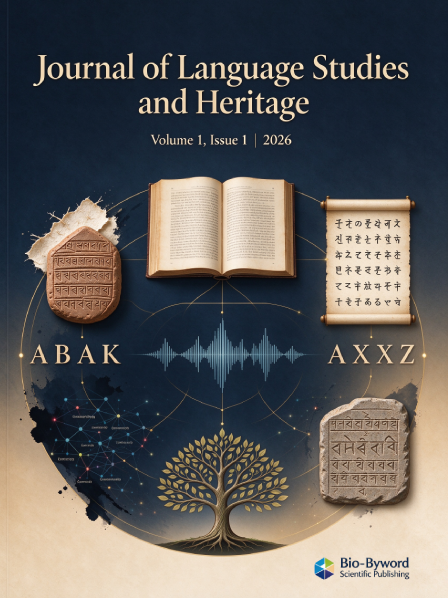
ISSN TBA
Journal of Language Studies and Heritage
The Journal of Language Studies and Heritage (JLSH) is an international, peer-reviewed academic journal dedicated to the interdisciplinary study of language and the preservation of linguistic heritage. The journal provides a platform for scholars, linguists, and digital humanists to disseminate original research that bridges modern linguistic inquiry with the safeguarding of historical, indigenous, and endangered languages.
JLSH embraces the intersection of traditional philology and modern language science. By fostering dialogue across phonetics, sociolinguistics, corpus linguistics, and digital archiving, the journal aims to advance the understanding of language evolution, linguistic diversity, and the innovative application of digital technologies in preserving cultural heritage.
The Journal of Language Studies and Heritage (JLSH) aims to serve as an international, peer-reviewed platform for interdisciplinary research that bridges modern linguistic inquiry with the documentation, preservation, and revitalization of language heritage. The journal is committed to advancing scholarly understanding of language evolution, linguistic diversity, and the innovative application of digital technologies in safeguarding historical, indigenous, and endangered languages. By fostering dialogue across linguistics, philology, digital humanities, and heritage studies, JLSH seeks to contribute to the sustainable preservation of linguistic and cultural heritage worldwide.
Scope
JLSH welcomes original theoretical and empirical contributions, including research articles, review papers, and case studies. The journal’s scope encompasses, but is not limited to, the following core areas:
-
Linguistic Theory and Empirical Research: Phonetics, phonology, syntax, semantics, pragmatics, and corpus linguistics.
-
Language Heritage and Documentation: Endangered language documentation, historical linguistics, philology, and manuscript studies.
-
Digital Humanities and Language Technology: Digital archiving of ancient texts, linguistic data visualization, network analysis of language, and computational approaches to heritage languages.
-
Sociolinguistics and Anthropological Linguistics: Language contact, language policy, dialectology, and the relationship between language, culture, and identity.
-
Language Revitalization and Education: Community-based language revitalization, language acquisition, and pedagogical approaches for heritage language learners.
-
Translation and Cross-Cultural Communication: Translation studies, interpretation, and cross-linguistic communication in heritage contexts.
